Infinite Library
Infinite Library is a side-scroller puzzle platformer I worked on with a team of 6 other devs for A&M's 2024 Game Development class as art lead. This page details my work on the project over the course of the 14-week development period.
My main contributions to the project as art lead include:
-
Art Direction - establishing the look and feel for all the game's visuals
-
Environment Art - creating environment concepts and modular kits; directing 3D prop asset creation
-
Lighting - establishing mood and attention points for each level, working with devs to ensure optimization.
-
Cutscene Art - creating the artwork shown in the intro/outro cutscene sequences
Check out the game on itch.io: https://darkstorminteractive.itch.io/infinite-library
This project was a team effort. Shown below are my contributions.


Promotional Art, Infinite Library
Modular Environment Set

Training Center, Infinite Library

Early Concept Art of the Library
Creating The Library:
The concept behind the Library was to depict a vast, eerie, and mostly empty world surrounded by towering walls of bookshelves that expand infinitely in every direction. Before I pitched this idea for a game to my team, I was challenged to find ways to breath life and identity into an otherwise lonely idea for a world. I had heard of Jorge Luis Borges' "The Library of Babel" from a class reading assignment and became fascinated with the idea of an endless library. What kinds of people could exist in such a place? What kinds of threats could exist there? The ideas for adapting this concept for a world into a video game are as infinite as the Library itself.
We drew reference mainly from the game, Inside, a side-scroller platformer featuring a small character in a very gritty and ominous world. We knew we wanted the game to be a puzzle platformer featuring physics interactions between the player and the world, so it made sense for the environment to feature components that enable platforming: floating debris, extensive rooms or "sectors"; the ideas were endless. The idea became that the player character would be the lone Librarian of the Library, albeit with implications of other people existing somewhere and leaving occasional messages for the player to find on book podiums. It was quickly determined that our version of the infinite library would be techy and somewhat industrial, as opposed to the popular depictions of it being mostly wooden and antiquated. As someone who loves sci-fi stuff, I drew visual inspiration from some of my favorite franchises in that genre: Tron, Portal, and Star Wars.


Alex's Room, The Dark Archives


Study Hall, Training Center, Corrupted Corridor
The concept for the room the player would begin the game in, Alex's room, really set the tone for the shape language and color the art team would use for later environment pieces. After the first half of the game had been whiteboxed, I worked on sectioning each area and adapting it to make it feel like a place someone would live or work in. After this was done, I finished concepts based on our current plans for obstacles, enemies, and player abilities, all of which ended up changing considerably as development progressed.
For instance, the training center was meant to teach the player how to fight with their light sword as well as the basics of interacting with a book of power. Combat was meant to be as big a part of the game as puzzle-solving, hence the reason Alex has a sword attached to her arm. We had working attack animations and enemies made of glowing corrupted text that would craw out of pits (as shown in the corrupted corridor concept) and also had plans for the bird enemies to be a challenging enemy once the player reached the Dark Archives, but this was scrapped due to rescoping and the decision to shift the focus completely to physics-based puzzle solving.
Up until late in development, the player would have acquired a total of 5 Books of Power as opposed to the 3 featured in-game now. They would have had to use a book called the Light Book to prevent enemies from spawning in hoards in order to progress through areas like the corrupted corridor. This book became the Impulse Book in our final build. We also intended for the green energy gates to be impassable without a Gateway Book in hand, but as our puzzle ideas developed, this became irrelevant.


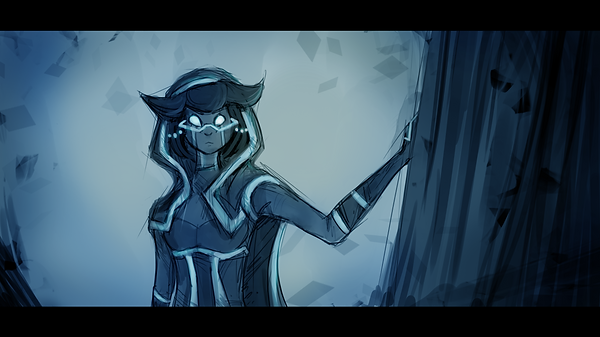
Intro Cutscene Art
We didn't actually finalize how long the game would be or how it would end until the late stages of development. We knew we wanted a boss battle to compensate for the lack of combat, and this added complexity resulted in the need for cutscenes to establish the context for the game. I wrote the script intending to introduce the player to a concise idea of the world, themselves, and their goal, with lots of room left for creative interpretation. The end cutscene came much later after the ending of the game had been settled.


Outro Cutscene Art